Free Energy and Shannon Entropy
FW26, William Gates Building
This Session
- No laptops; homework from Weeks 1–2 (Quiz 1 / Worksheet 1)
- Heat as far as Joule before the break
- Helmholtz \(F=U-TS\) on the board after the break (LO1)
- Clausius after Helmholtz; Shannon / Jaynes / Wiener as a preview
Homework from Weeks 1–2
No Quiz Today
Worksheet 1 and Quiz 1 are marked. Today we spend a few minutes on what the scripts showed, then finish Week 2.
- Comments already sent by email;
- Quiz 1: fifteen papers from people who had Week 1; mean \(8.2/10\)
- Worksheet 1: thirteen scripts; mean \(12.2/15\)
Quiz 1
Quiz 1: Where Marks Moved
Mean \(8.2/10\). Two items accounted for most of the misses.
- Demon versus gremlin: about three in five missed it
- Energy as a machine-learning score: about half got this wrong
- Entropy as limit versus probability as prescription: one in five
Gremlin, Not Demon
Maxwell’s demon sorts. Laplace’s gremlin is the admission that complete knowledge is not available in practice.
- The demon is an intelligent mechanism at a trap door
- The gremlin is not a mind in the box; it is a limit on what we can know
- Shannon’s \(H\), in an hour, is a calculus for that incomplete knowledge
Energy Is a Score
In machine learning, energy is a preference: lower is more probable.
- \(p_i \propto e^{-\beta E_i}\): the occupation from Week 1
- Quadratic loss and cross-entropy are energy-like objectives
- The word energy does not, by itself, buy you a heat bath
Worksheet 1
Worksheet 1: The Habit
Curiosity ran slightly ahead of skepticism. Reflection was where the conversation was least often turned back on itself.
- Mean \(12.2/15\); the dialogues did the job
- Strongest work expanded after the first thread, then challenged without collapsing the chat
- Weaker work ratholed, or let the model agree and stop
The See-Saw
A direct challenge is often met by sycophancy: the model agrees, and the conversation has nowhere to go.
- Concede the part you accept; then ask what follows
- Admitting “this may be my misunderstanding” denies the model the chance to merely please
- Grasshopper is not sycophantic … the models are.
Expand, Then Return
Once a thread is established, step back. Ten turns is enough to open a second front and still close.
- Early precision is good; staying there for six turns is not
- State the model’s point in your prompt, then ask the adjacent question
- Smaller models sometimes left more to work with than verbose ones
Who Made Entropy Uncertainty?
Clausius did not. A question most chats approached and few quite landed.
- Clausius: a thermodynamic accounting identity
- Uncertainty as entropy is already in the statistical tradition — Boltzmann, Gibbs, then Wiener’s “ignorance”
- Shannon’s footnote is Tolman, not the cocktail-party story
Worksheet 2 Is Already Out
Same habit, different claim: is Shannon’s \(H\) Boltzmann’s \(S\), or an analogy?
- Due 10:00 at the start of lecture 4 (3 November)
- Open on the equivalence; then press sample space, discrete vs continuous, what \(p\) is over
- Use the see-saw lesson: concede, then move. Do not rathole on the first definition.
From Heat to Helmholtz
The Story of the Lecture
Heat first. Information after Helmholtz.
- Black \(\to\) Carnot \(\to\) Rumford \(\to\) air thermometer \(\to\) Kelvin \(\to\) Joule
- Helmholtz on the board after the break; Clausius after Helmholtz
- Shannon / Jaynes / Wiener as a preview; entropy game / MacKay next week
Joseph Black and Heat as a Quantity
Joseph Black
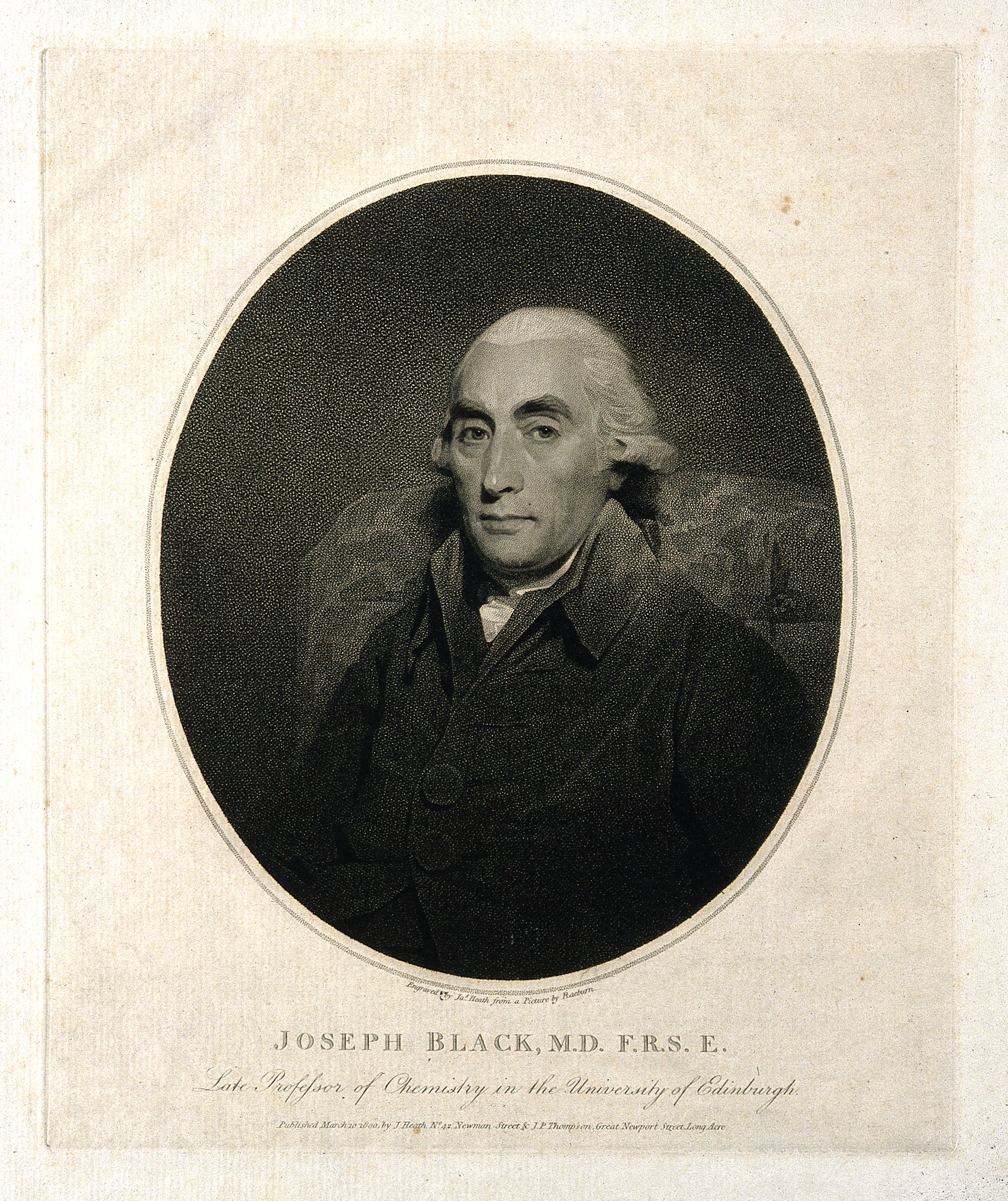
The Problem
Ice melts. The thermometer does not move.
- Heat is entering the mixture
- Temperature stays at the melting point until the ice is gone
- If heat were temperature, that would be a contradiction
Heat Is Not Temperature
Temperature is the reading. Heat is what you add.
- Mix two bodies of known mass and starting temperature; one final reading
- Equal heat, equal mass: mercury rises more than water — different capacity
- Ice melts with the thermometer stuck — heat can be hidden
The Ice Calorimeter
Black mixed and timed. This box weighs meltwater.
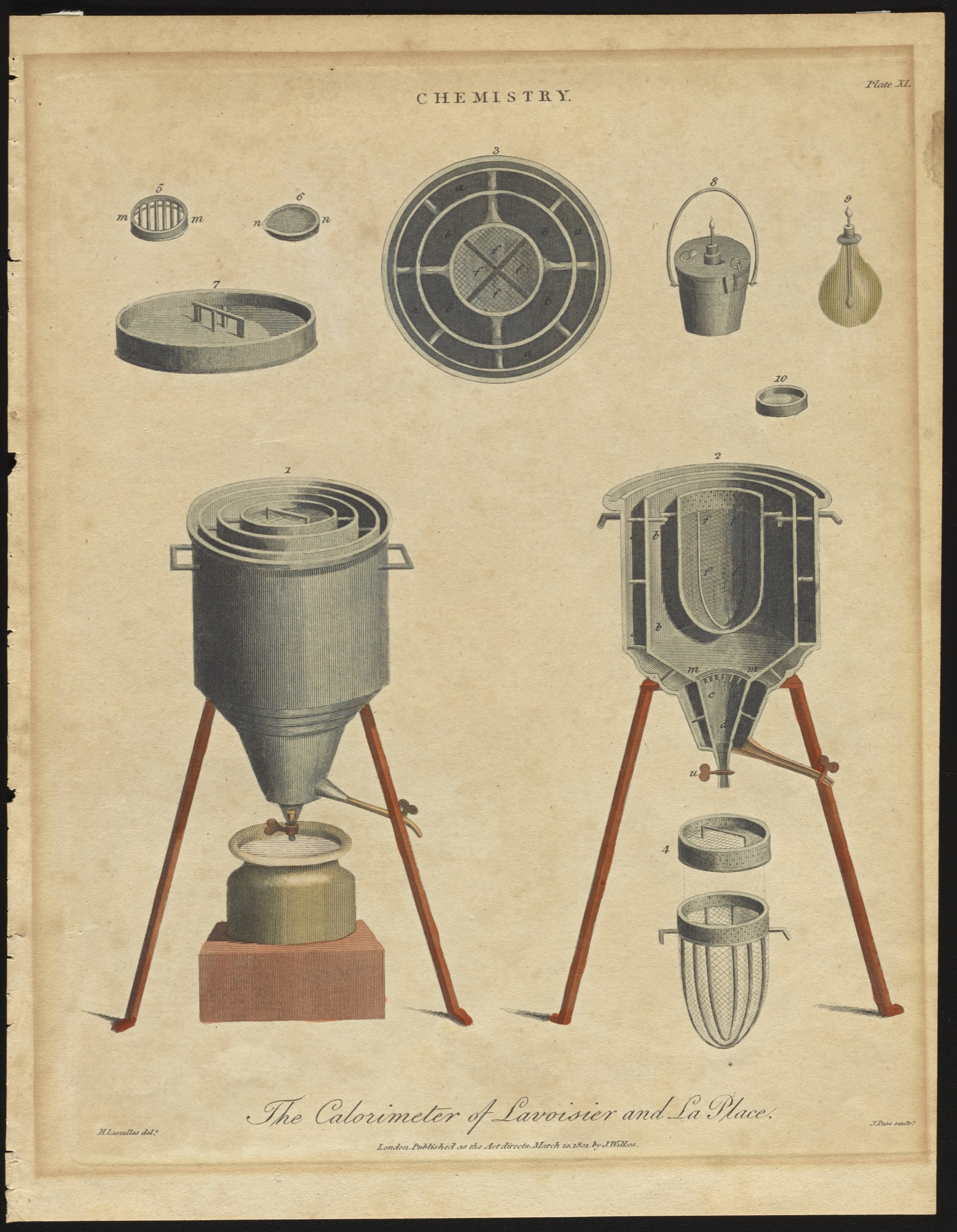
- Heat leaving the sample melts ice in the jacket
- You weigh what melted — that is the heat
- The conversion is Black’s latent heat of fusion
Latent Heat of Steam
A kettle on a steady fire. Time is the meter.
- Clock the water from ice-cold to the boil; then clock it boiling dry
- Boiling dry takes about four and a half times as long
- That extra heat does not move the thermometer. Black calls it latent
Sadi Carnot and the Fall of Heat
Sadi Carnot
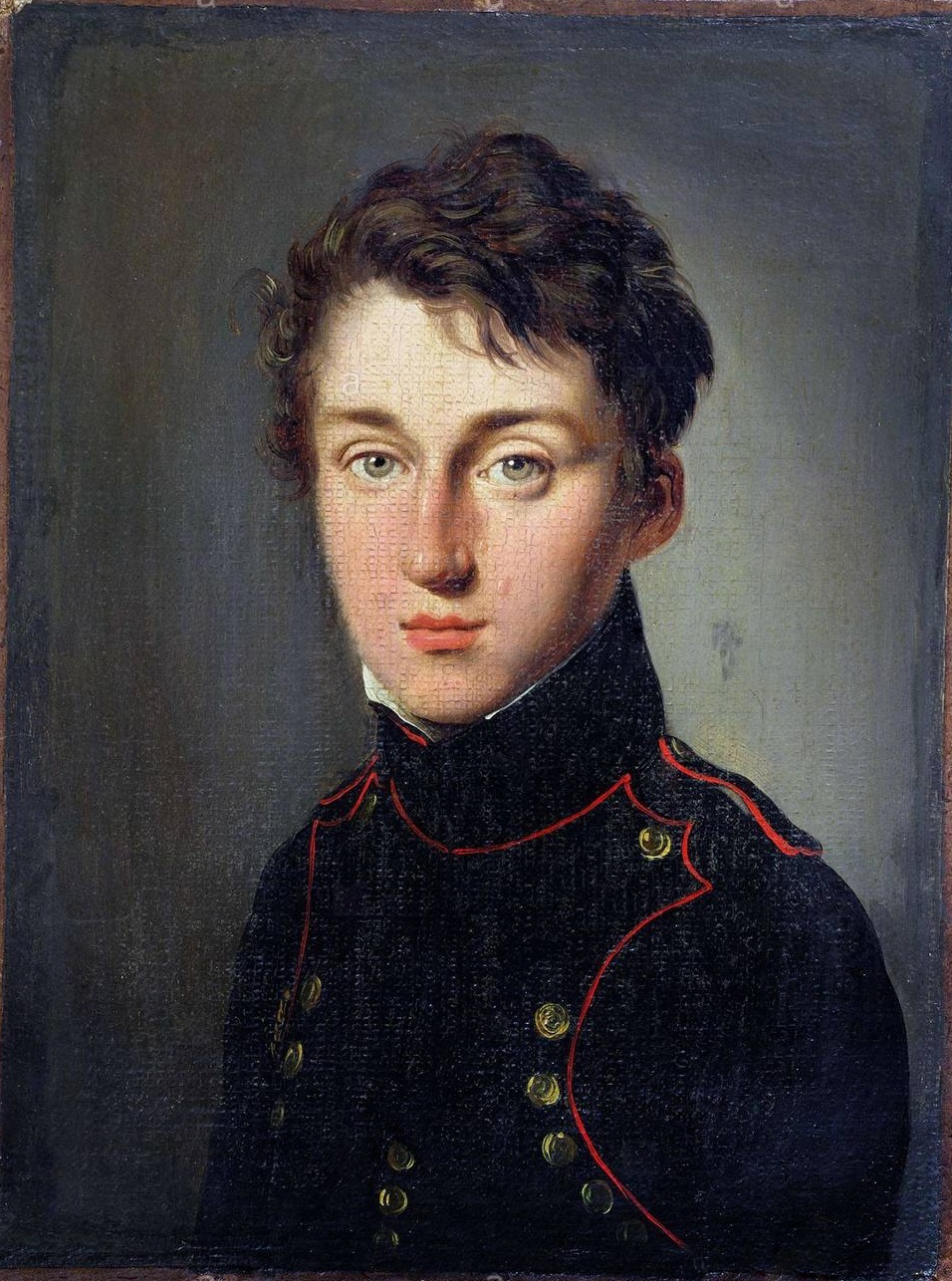
Why Look at Heat Engines?
Steam already drives mills, mines, and looms. Nobody has a theory of it.
- Watt’s engines are a British industrial fact
- Engineers try higher pressure, and other fluids than steam
- Carnot: is there a limit? Does the choice of fluid matter?
The Réflexions
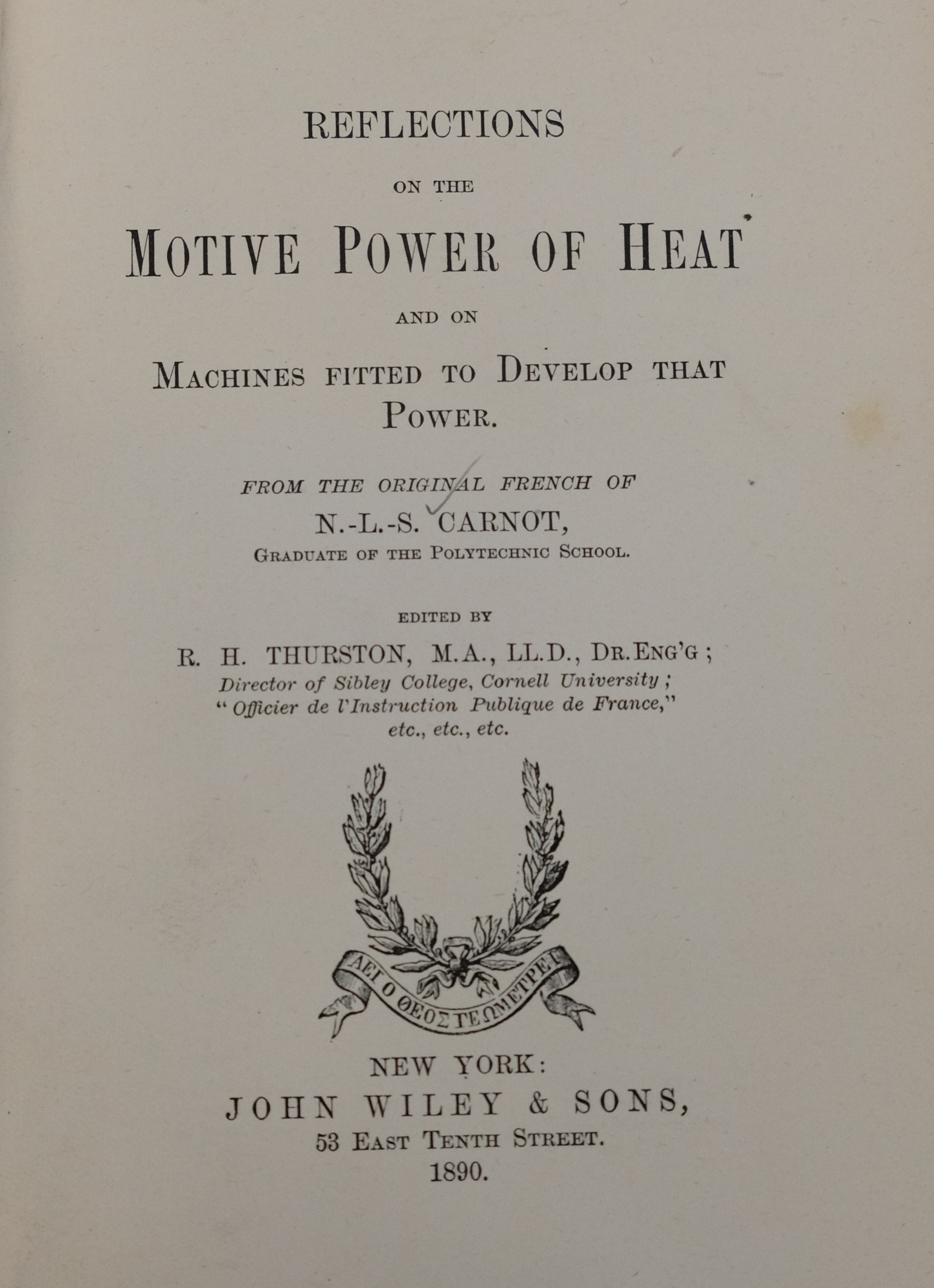
A Heat Engine Is a Mill
Caloric falls from hot to cold. The same caloric arrives at the bottom.
- Water mill: quantity of water, height of the fall; the same water arrives below
- Heat engine: quantity of caloric, difference of temperature; the same caloric arrives in the condenser
- Two reservoirs. Nothing is used up.
A Short Life
Carnot dies in the 1832 cholera epidemic, aged 36. The book almost vanishes with him.
- Six hundred copies, paid for by the author, unread
- Clapeyron recasts the argument in 1834
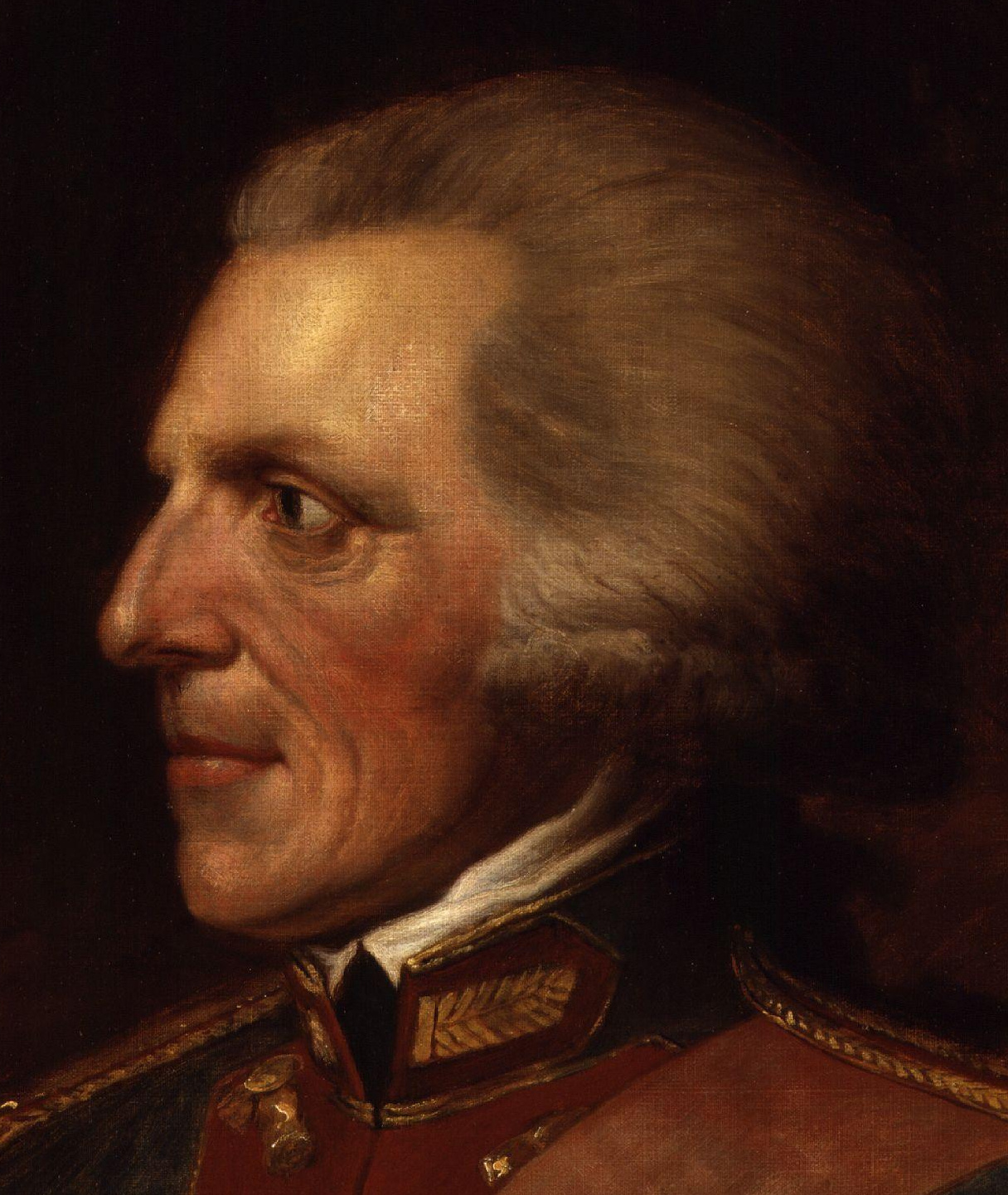
Count Rumford’s Cannon
Count Rumford
The Cannon
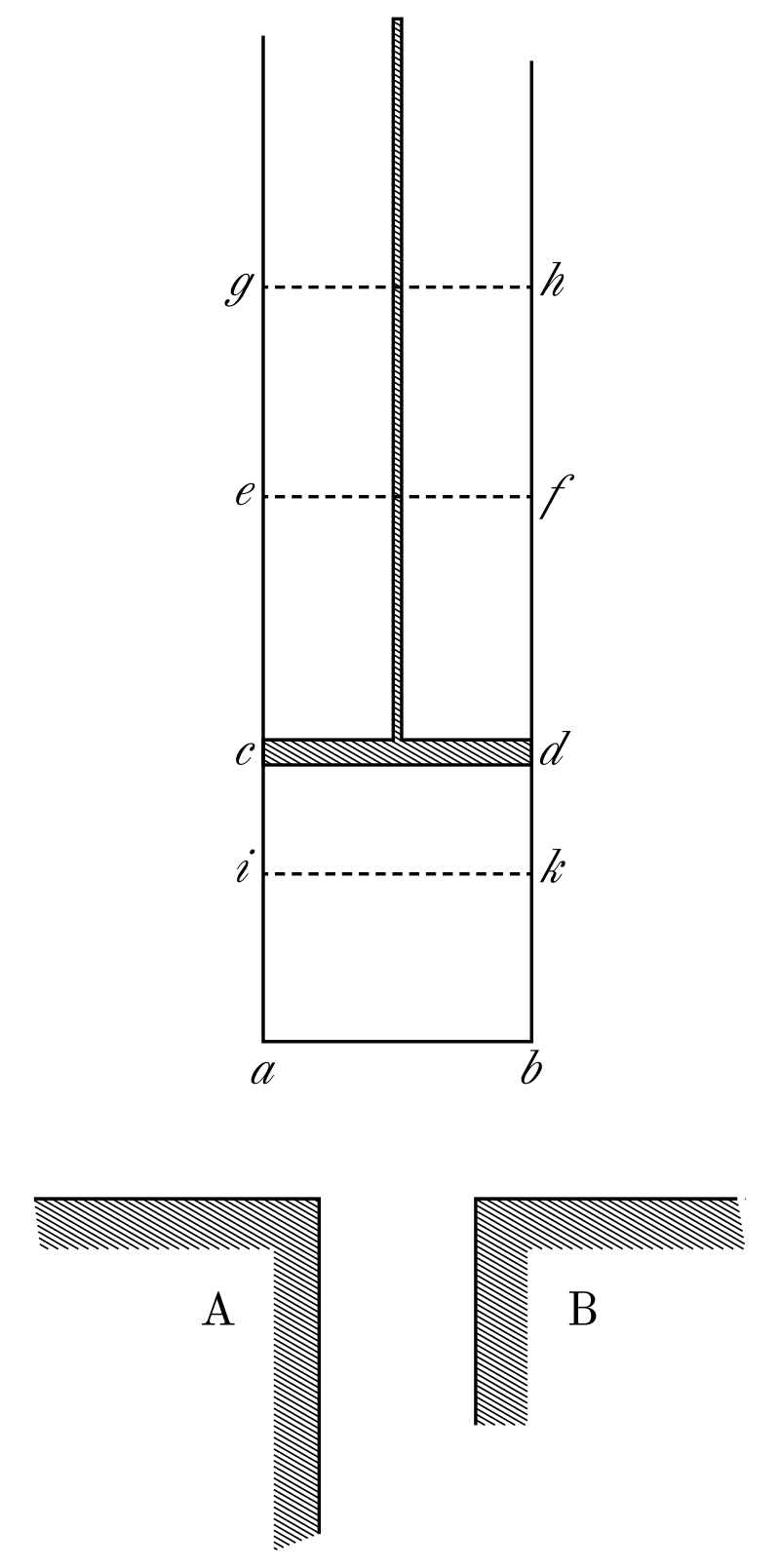
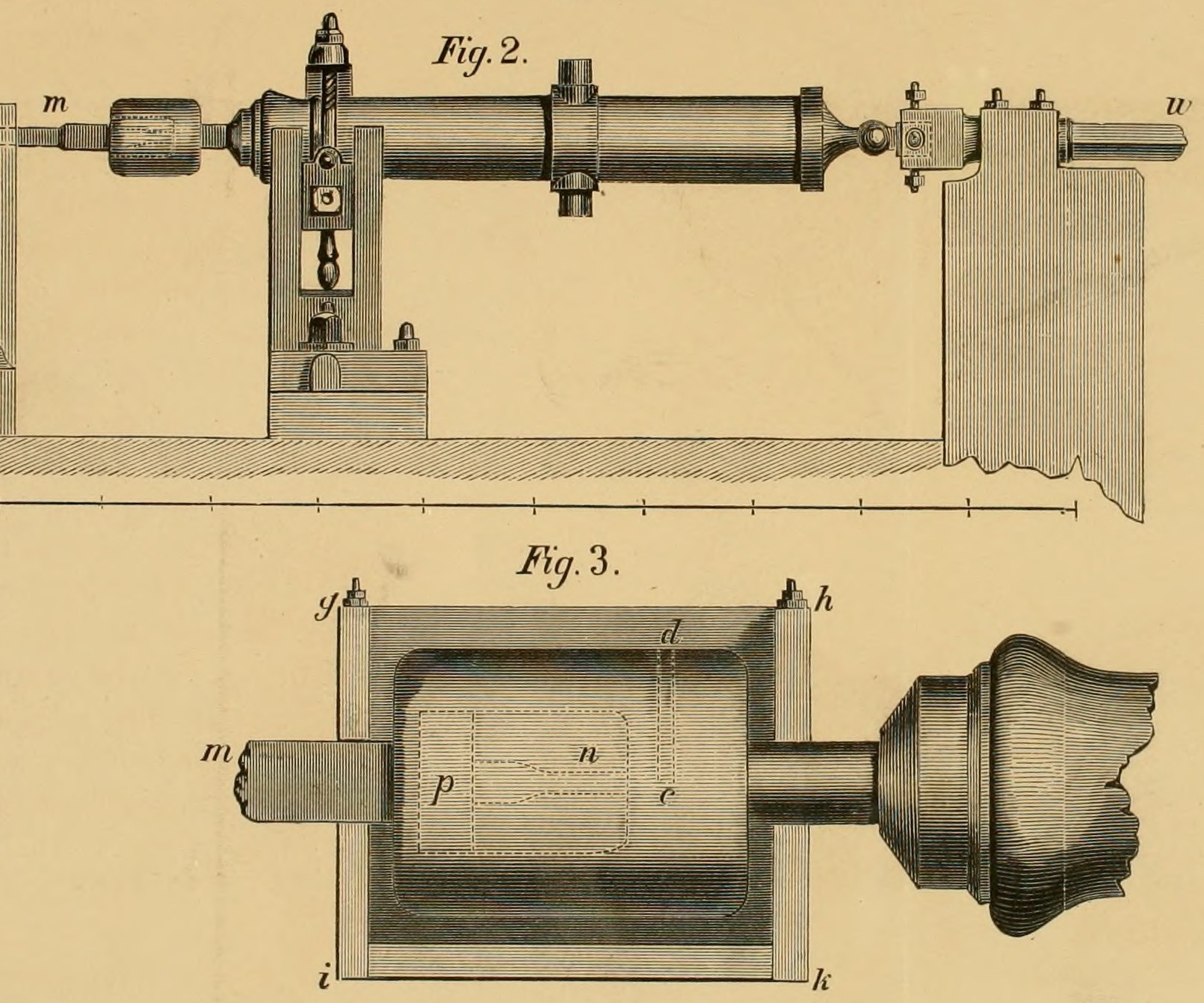
A blunt borer, a brass cylinder, a box of water, horses turning the gun.
- About \(18.8\,\mathrm{lb}\) of water, starting at \(60^\circ\mathrm{F}\)
- The cylinder at about \(32\) turns a minute
- After two hours and thirty minutes the water boils — with no fire
Rumford’s Apparatus
Inexhaustible
Furnishing heat without limitation …
- The chips do not lose a hidden store of caloric
- The heat continues as long as the work continues
- Rumford’s conclusion: heat is a mode of motion
Mercury, Ice, Steam, and Air
Fahrenheit and Celsius
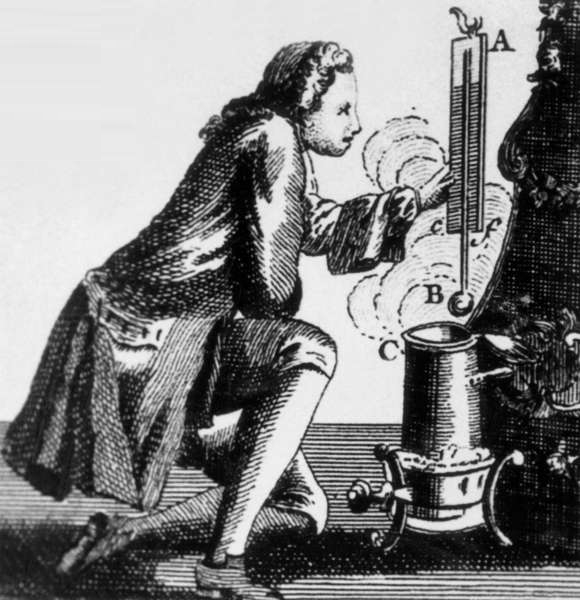
A degree is an equal expansion of mercury. Ice and steam are the pins.
- Fahrenheit (1724): mercury; ice at \(32\), steam at \(212\)
- Celsius (1742): the same two pins, later numbered \(0\) and \(100\)
- Neither scale is heat. Both are the expansion of one liquid
The Air Thermometer
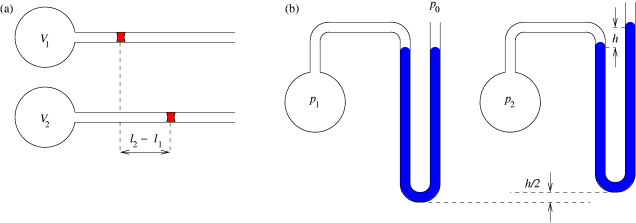
The laboratory standard is air, not mercury. Pressure is held at the room’s.
- Trap a mass of air behind mercury that is open to the atmosphere
- Slide the thread, or lower the cistern, until the mercury surfaces are level
- Volume is then the reading; ice and steam still pin \(0\) and \(100\)
Thomson’s Scale from the Mill
William Thomson
What a Degree Is
The pins are a century old. He is defining the degree.
- Fahrenheit, Celsius, air: a degree is equal expansion of one substance
- Thomson, aged 24: a degree is an equal fall of caloric — the same motive power from the same quantity of heat, anywhere on the scale
- Ice remains \(0\), steam remains \(100\). He has not moved the pins. He has defined the rungs.
An Absolute Thermometer
A degree is a height of fall of conserved heat. Ice is still \(0\), steam still \(100\).
- Take a unit of heat from a body at \(T\) on this scale
- Let it fall to a body at \(T-1\); the same unit arrives
- A perfect mill in between always gives the same motive power, whatever \(T\) is
Is There a Bottom?
In 1848 the mill has no bottom. Infinite cold is infinitely far down.
- Air already suggests a wall: its volume would vanish at about \(-273^\circ\)
- That number is Gay-Lussac’s expansion, not Carnot’s mill
- Thomson still pins \(0\) at ice; on his mill scale you can always fall one more equal degree
Heat Is Not Destroyed
He still thinks with Carnot. Heat is conserved. The mill turns because caloric falls.
- A unit of heat that leaves the hot body arrives at the cold
- Motive power is the mill, not heat being used up
- ``The conversion of heat into mechanical effect is probably impossible, certainly undiscovered’’
Joule and the Mechanical Equivalent
James Prescott Joule
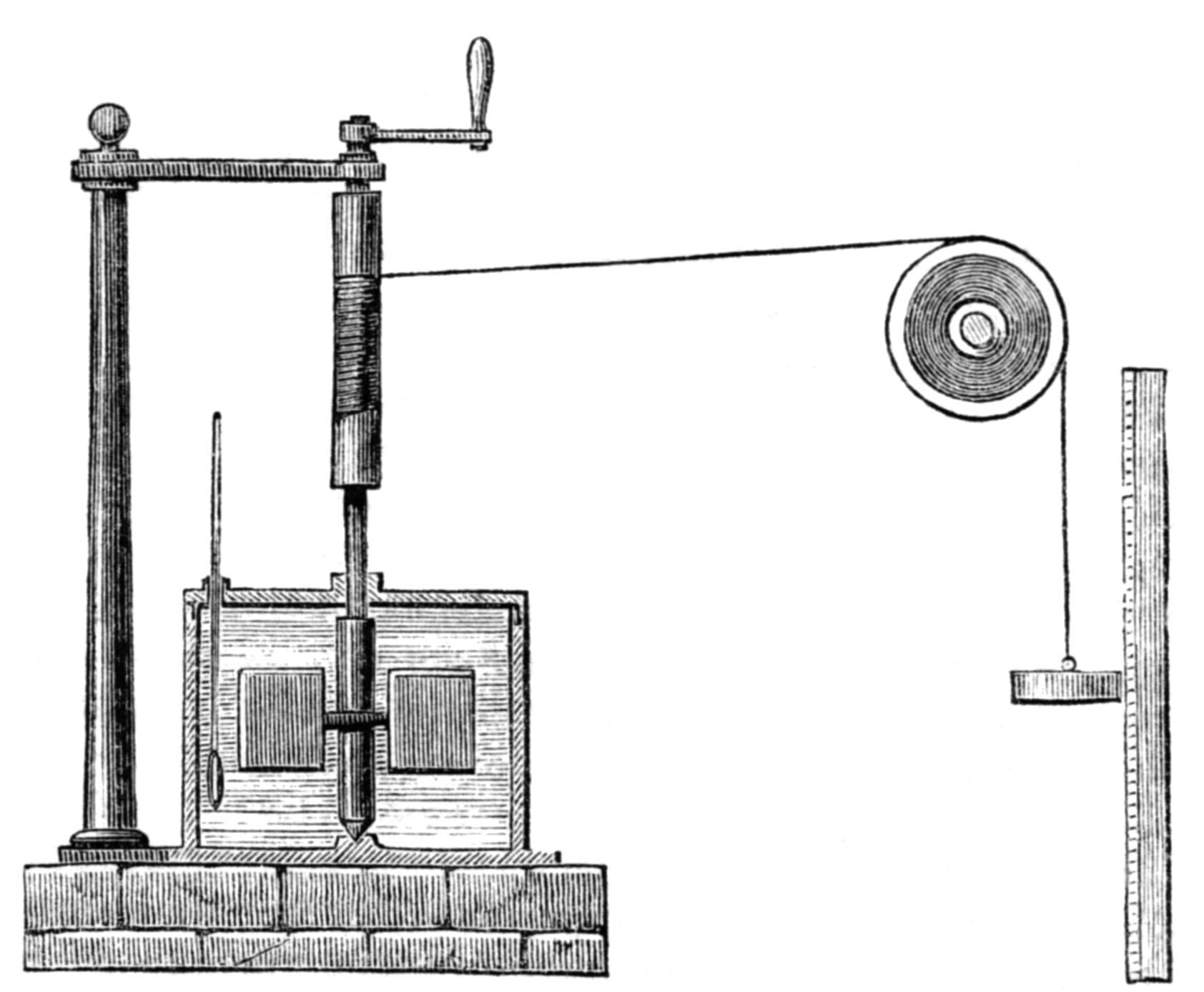
The Paddle Wheel
A Number
A definite amount of work makes a definite amount of heat.
- 1845, British Association at Cambridge: the paddle already gives an equivalent, still scattered
- 1850, Philosophical Transactions: \(772\) foot-pounds to raise \(1\,\mathrm{lb}\) of water by \(1^\circ\mathrm{F}\)
- Modern, on the same scale: about \(778\) foot-pounds, or \(4.186\,\mathrm{J}\) per calorie
Not Carnot’s Question
Joule is converting work into heat. He is not running a mill between two baths.
- Carnot: maximum work from a fall of conserved caloric
- Joule: how much work makes how much heat
- Conservation of heat cannot be the general law if the paddle is right
The Contradiction
You cannot keep Carnot’s conserved heat and Joule’s equivalent as general laws.
- If heat is conserved, none of it becomes work
- If Joule is right, some of it does
- What can be kept: a limit that depends only on the two temperatures
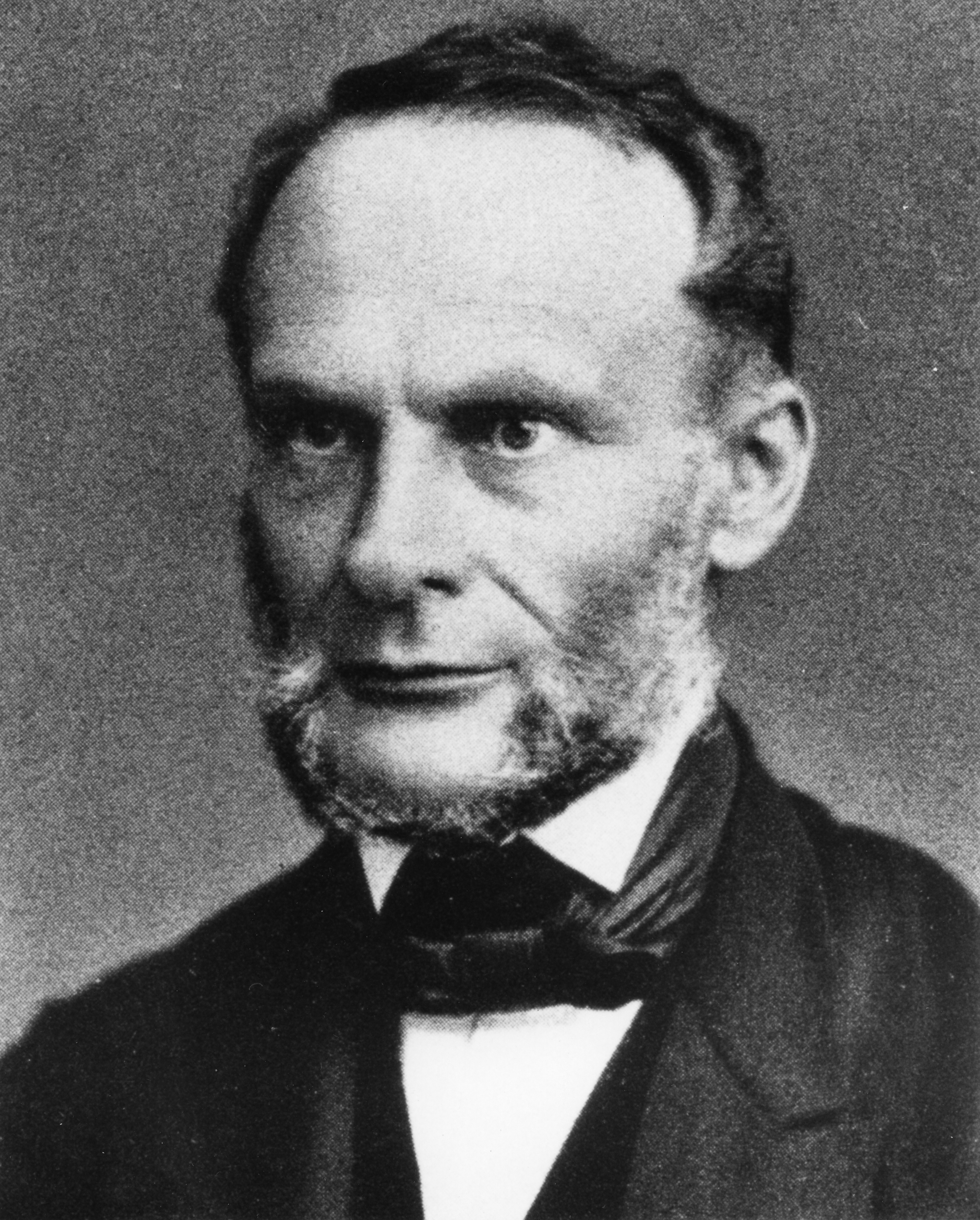
Clausius and \(\mathrm{d}Q/T\)
Rudolf Clausius
Two Laws
Keep Joule’s equivalent. Keep Carnot’s limit. Drop conservation of heat.
- First law: heat and work are interchangeable, at Joule’s rate
- Second law: heat does not flow from cold to hot without a cost
- A cycle cannot turn the heat of one bath entirely into work
The Ratio that Survives
After Joule, Carnot’s mill is a ratio of heats, not a conserved fluid.
- Reversible engine: \(Q_h/T_h = Q_c/T_c\)
- \(Q_h\) taken from the hot bath, \(Q_c\) delivered to the cold
- Heat does not balance. Heat over temperature does
The Loop
A reversible cycle is a closed path. If it is reversible, the integral is zero.
\[\oint \frac{\mathrm{d}Q}{T} = 0 \qquad \text{(reversible cycle)}\]
- Every reversible loop integrates to zero
- So there is a state function \(S\) with \(\mathrm{d}S = \mathrm{d}Q_{\mathrm{rev}}/T\)
A Reversible Cycle Produces No Entropy
You return to the start. Nothing has been created.
- The working substance: \(S\) is a state function, so \(\Delta S = 0\) around any cycle
- The baths: the entropy that left the hot bath arrives at the cold bath
- Universe: \(\Delta S = 0\). A reversible cycle produces no entropy
When the Cycle Is Irreversible
The working substance still comes home. The books do not.
- Friction, a finite drop of temperature, a paddle in the mechanism
- More heat is dumped to the cold bath than the reversible case
- \(\displaystyle\oint \mathrm{d}Q/T < 0\), and the entropy of the universe increases
The Name
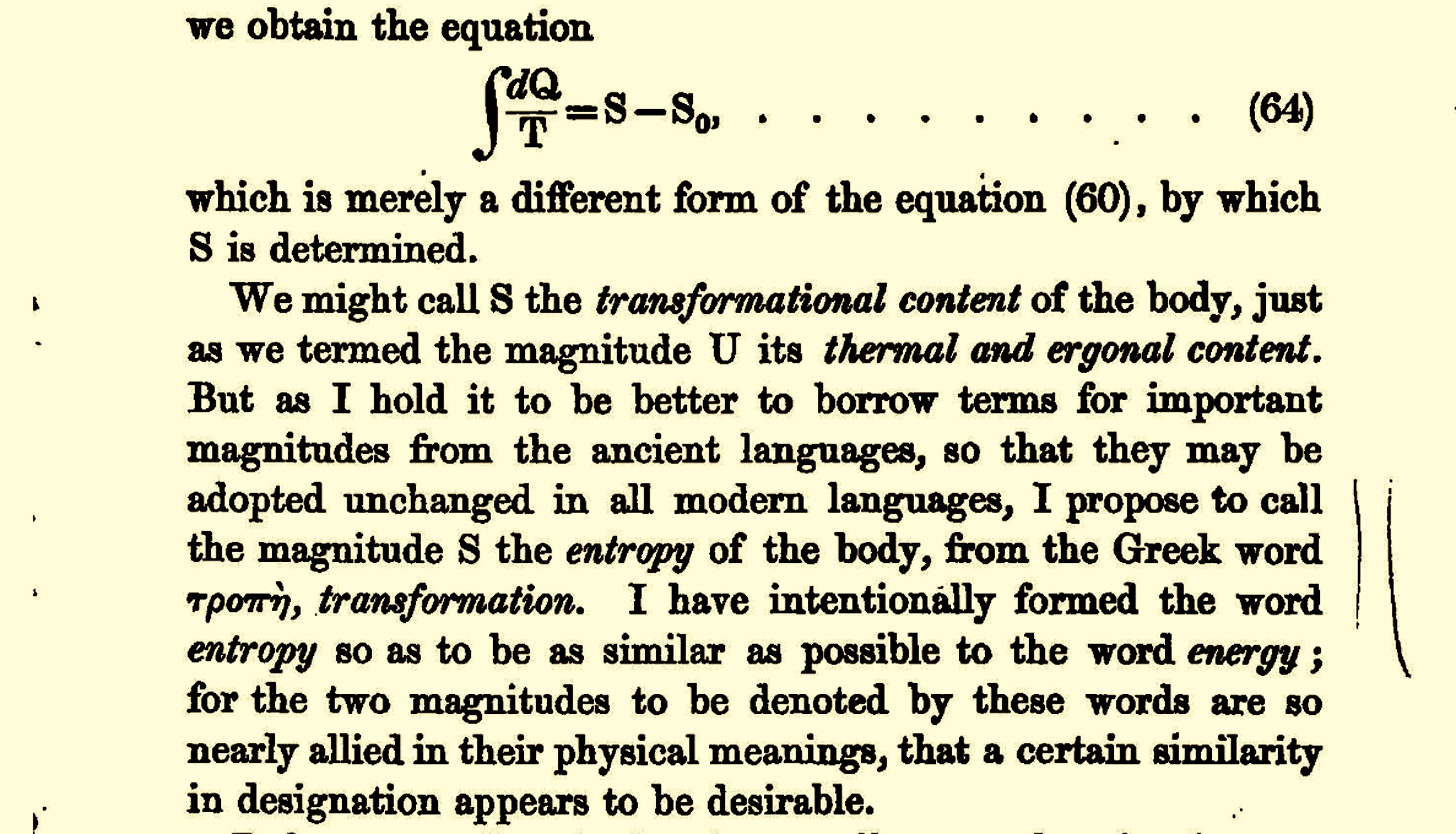
Not Uncertainty
Clausius’s \(S\) is the piece that fits the puzzle: heat divided by temperature.
- Macroscopic: \(S\) from \(\mathrm{d}Q_{\mathrm{rev}}/T\); a reversible cycle produces none
- Microscopic, later: Maxwell, Boltzmann, Gibbs count the same \(S\)
- Information, later: Shannon, Jaynes reuse the functional form for a different job
Thomson Returns: The Scale After Joule
Thomson, 1851
The 1848 scale assumed conserved heat. After Joule that assumption is gone.
- Clausius, 1850: two laws; Carnot’s ceiling without caloric conservation
- Thomson, 1851: accepts Joule; heat is not a conserved fluid
- What survives: a reversible engine still has a limit that depends only on the two temperatures
The Ratio, Not the Fall
In 1854 Thomson and Joule replace equal mill-degrees by a proportion of the two heats.
- Reversible engine: \(\displaystyle\frac{Q_h}{T_h} = \frac{Q_c}{T_c}\)
- The same identity Clausius wrote as \(\mathrm{d}S = \mathrm{d}Q_{\mathrm{rev}}/T\)
- Absolute temperatures are now those for which this ratio holds
Now There Is a Bottom
Absolute zero is where a reversible engine would reject no heat.
- \(T=0\) is \(Q_c=0\) for a perfect mill between \(T_h\) and the floor
- The air thermometer’s \(-273^\circ\) was vanishing volume; this is vanishing rejected heat
- Infinite cold is no longer infinitely far down the mill
Molecules
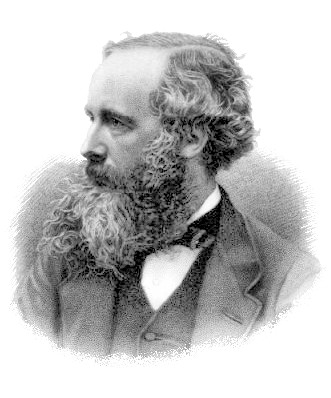
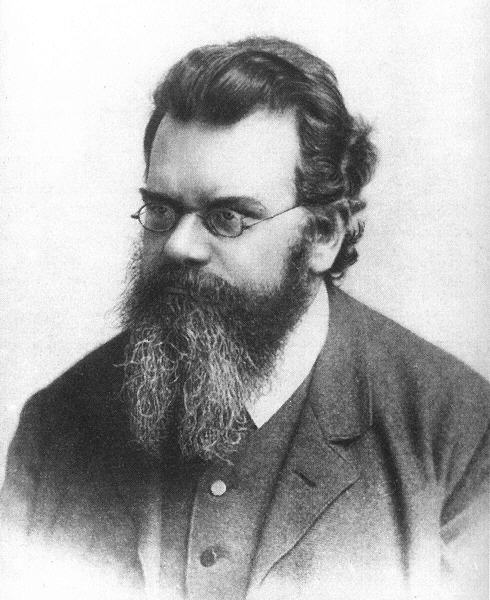
Maxwell–Boltzmann: Components Versus Speed
Each Cartesian velocity component is Gaussian. Speed \(v=|\mathbf{v}|\) is not.
- Component: \(f(v_x)=\sqrt{m/(2\pi kT)}\,e^{-mv_x^2/2kT}\)
- Speed: integrate the isotropic 3D Gaussian over angles
- Jacobian \(d^3v = v^2\,dv\,d\Omega\) supplies the \(v^2\) factor
Same Physics, Different Variable
\[ f(v_x)=\sqrt{\tfrac{m}{2\pi kT}}\,e^{-mv_x^2/2kT} \qquad\text{versus}\qquad f(v)\propto v^2\,e^{-mv^2/2kT} \]
- The \(v^2\) is not an energy correction — it is geometry
- Each component is the quadratic \(E=mv_x^2/2\) whose expectation we split next
The Gibbs–Boltzmann Distribution
Gibbs–Boltzmann Occupation
Same formula, three names: Boltzmann weights, Gibbs distribution, canonical ensemble.
- \(p_i = e^{-\beta E_i}/Z\), \(\quad Z(\beta)=\sum_j e^{-\beta E_j}\)
- \(\beta=1/k_B T\): coldness; \(T\): bath temperature
- \(\log Z\) is the cumulant generating function of the energy
Aside: Hopfield, Boltzmann Machines, Nobel 2024
The same energy-and-occupation grammar reappears in associative memory and early deep learning.
- Hopfield (1982): fixed-weight energy; recall as settling
- Boltzmann machine (1985): make those couplings learnable
- Pairwise energy: \(E(\mathbf{s})=-\sum_i b_i s_i-\sum_{i<j}W_{ij}s_i s_j\)
Coldness and Temperature
- \(T\): the bath, the thermometer
- \(\beta = 1/k_B T\): coldness
- Same occupation; entropy sits in a different place
Two Representations
- \(T\)-first: \(F = U - TS\)
- \(\beta\)-first: \(Z(\beta)\), then \(U = -\partial_\beta\log Z\)
- Week 5: \(\beta\) is the Lagrange multiplier
Free Energy Decomposition
From Occupation to Accounting
From Gibbs distribution to energy bookkeeping.
- \(p(x)=e^{-\beta E(x)}/Z\)
- Equilibrium: inner energy is an expectation, \(U=\left\langle E\right\rangle\)
- Algebra then defines \(F\) and \(S\)
Take the Logarithm
\[ \log p(x) = -\beta E(x) - \log Z \]
- Solve for the microscopic score: \(E(x)=-k_BT\log p(x)-k_BT\log Z\)
- \(1/\beta=k_BT\) converts coldness back to the bath’s temperature
Equilibrium Identifies \(U\) with \(\left\langle E\right\rangle\)
\[ U \equiv \left\langle E\right\rangle = \sum_x p(x)\, E(x) \]
- \(E(x)\) is a score on configurations
- \(U\) is what a calorimeter would call the energy of the system
- The move is the ensemble: replace a number by an expectation
Name the Two Remaining Terms
\[ U = \underbrace{-k_BT\log Z}_{F} + T\underbrace{\bigl(-k_B\sum_x p(x)\log p(x)\bigr)}_{S} \]
- Helmholtz free energy: \(F=-k_BT\log Z\)
- Boltzmann entropy: \(S=-k_B\sum_x p(x)\log p(x)=k_B H\)
- Hence \(U=F+TS\), or \(F=U-TS\)
Two Temperatures, One Identity
- \(T\)-first: \(F=U-TS\) — energy, then entropy’s cut
- \(\beta\)-first: \(F=-\beta^{-1}\log Z\), then \(U=-\partial_\beta\log Z\)
- Same numbers; week 5 makes \(\beta\) a Lagrange multiplier
Three-State Check
- Prescription: \(p(x)=e^{-\beta E(x)}/Z\)
- Accounting: \(F=U-TS\) with \(U=\left\langle E\right\rangle\)
As Taught: Helmholtz on the Board
Occupation to accounting, written by hand. Clausius slides come after.
- \(p_i = e^{-\beta E_i}/Z\); \(Z\) is Summe der Zustände
- Take the log; take the expectation; \(U\) splits into entropy and available energy
- Maxwell’s demon, here, is a warning about crossing coarse-graining levels — Week 4 is the treatment
The Carnot Cycle on \(T\)-\(S\)
The Fall of Caloric
Carnot compared the motive power of heat to a waterfall. He did not know whether the work was proportional to the height.
The Mill, Drawn as a Rectangle
Replace height by temperature and mass of water by entropy, and the mill is already a rectangle.
- Height \(h\) \(\leftrightarrow\) temperature \(T\)
- Mass of water \(\Delta m\) \(\leftrightarrow\) entropy transferred \(\Delta S\)
- Fill at the top \(\leftrightarrow\) take in entropy at \(T_h\)
- Loaded bucket descends \(\leftrightarrow\) isolated expansion (the working body cools; no heat transfer)
- Empty at the bottom \(\leftrightarrow\) reject entropy at \(T_c\)
- Empty bucket returns \(\leftrightarrow\) isolated compression
- Work \(g\,\Delta h\,\Delta m\) \(\leftrightarrow\) work \(\Delta T\times\Delta S\)
The Square
The ideal Carnot cycle on a \(T\)–\(S\) diagram is a square.
- Expansion at \(T_h\): entropy increases, volume increases
- Isolated cool: adiabatic expansion, entropy holds
- Contraction at \(T_c\): entropy comes back down (Watt’s condenser)
- Isolated heat: adiabatic compression, the square closes
- Work is the area: \(W=\Delta T\times\Delta S\)
The Fall Is Not the Downward Stroke
Carnot’s fall is the difference between the reservoirs. The downward adiabat is the working body cooling with no heat transfer.
Four-Stroke, and the Smaller Loop
The four-stroke is the implementation. The square is the theory. Same \(\Delta T\), same \(\Delta S\): you cut two corners.
The \(p\)-\(V\) Chart
Engineers often draw the same strokes on a pressure-volume chart. In that case it no longer looks like a square.
Two Sides of the Same Coin
Welling’s Book, This Course
They named the book for \(F\). We named the course for \(S\). The hinge is \(U\).
- GAIST: A Tale of Free Energies — variational \(F\), ELBO, work and heat
- This course: entropy as the no-go; \(F\) as what remains after the cut \(TS\)
- Fix the inner energy \(U=\left\langle E\right\rangle\), and maximising \(S\) is minimising \(F\)
See also Friston
The same split, used as a theory of brains.
- Friston: organisms minimise a variational free energy (Friston-free10?)
- That functional is \(U[q]-T S[q]\) under a trial distribution \(q\)
- Named here. Developed later, if at all. Our no-go remains \(S\)
Preview: Shannon, Jaynes, Wiener
The same functional form, later, for a different job. We will try to push the jobs back together.
- Shannon and Jaynes reuse the Helmholtz / Gibbs form
- Shannon is discrete; Wiener is continuous
- Wiener never drops the mechanism; Shannon, you just say it is a probability
- Entropy game / MacKay: not reached on 27 October — next week
After Helmholtz: Not Reached
Define This Week
- Heat thread: Black \(\to\) Carnot \(\to\) Rumford \(\to\) air thermometer \(\to\) Kelvin \(\to\) Joule
- Helmholtz \(F=U-TS\); Clausius after; Welling reads \(F\), we read \(S\)
- Shannon / Jaynes / Wiener preview; entropy game / MacKay next week
After This Lecture
- Next: class test (Quiz 2), then grouping, then the demon
- Worksheet 2: \(H\) vs \(S\) — identity or metaphor?
Further Reading
The mill analogy: motive power of heat compared to a waterfall of Carnot (1824)
The 1848 absolute scale: equal mill-degrees, ice still zero; \(-273^\circ\) is the air thermometer, not his bottom of (Thomson-absolute48?)
The 1845 letter: paddle wheel shown at the British Association, Cambridge; equivalent still scattered around 817 foot-pounds of (Joule-equivalent45?)
The 1850 Phil. Trans. paper: \(772\) foot-pounds; the settled equivalent of (Joule-equivalent50?)
The 1850 paper: two laws, Carnot’s limit without conserved heat of (Clausius-motive50?)
The 1865 memoir: \(\mathrm{d}S = \mathrm{d}Q_{\mathrm{rev}}/T\), and the name entropy of (Clausius-entropy65?)
The 1851 dynamical theory: Joule accepted; Thomson’s form of the second law. The ratio scale with a bottom is 1854, with Joule of (Thomson-dynamical51?)
Boltzmann machines (optional colour) of Ackley et al. (1985)
Hopfield networks (optional colour) of Hopfield (1982)
The waterfall: quantity of liquid, height of the fall; he does not yet know if the work is proportional (Thurston pp.~60–61) of Carnot (1824)
Entropy as a resurrection of caloric of Falk (1985)
The mill drawn as a rectangle; caloric in the reversible model read as entropy of Meyn (2024)
A tale of free energies: the Helmholtz split is Ch.~3; we stay with entropy of Welling et al. (2026)
The free-energy principle: the same split, used as a theory of brains of (Friston-free10?)
Chapters 1–4 of Callen (1985)
Chapters 5–6 of Callen (1985)
Thanks!
- company: Trent AI
- book: The Atomic Human
- twitter: @lawrennd
- The Atomic Human
- newspaper: Guardian Profile Page
- blog: http://inverseprobability.com